
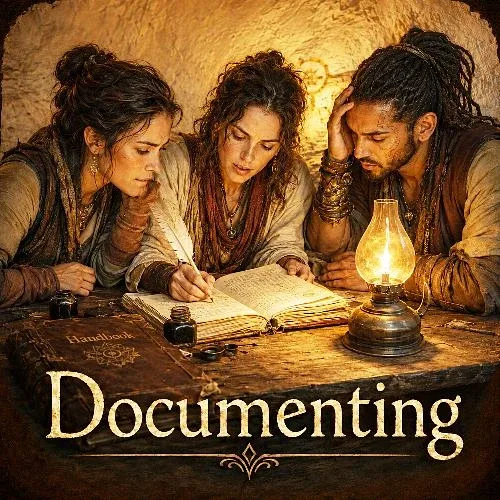
Documenting the Documenter
Documenting honors and pays respect to your Resources.
The Practice of Documenting is a crucial component of your journey on the Path. Why? Answer this question: How much have you benefited from other people's documentation?
A lot.
It is payback time.
You pay it back by paying it forward.
Here is what to document, and how.
If you don't write it down, it didn't happen.
Documenting Creates The Path
DOCUMENTING IS ALCHEMY
Documenting is a bridge between worlds.
Documenting is when something lived, felt, seen, discovered, intuited, realized, or tested in the Nonmaterial domain gets anchored into material Reality through ink, marks, symbols, language, diagrams, sketches, maps, lists, records.
Without documenting, the experience may have been real, but it remains ungrounded, untransmitted, and easily lost.
So documenting is not merely note-taking. It is:
- Integrating experience.
- Stabilizing new Thoughtware.
- Memory-building for the Being.
- Transformational Pathway for others.
- Infrastructure-making for next culture.
If you don't write it down, it didn't happen because it will fade away like a dream.
If you do not document it, how can it enter the culture?
It may remain only a private flash, a beautiful mirage.
Documenting turns:
- Experiment into knowledge.
- Insight into usable Thoughtware.
- Process into lineage.
- Discovery into Possibility for others.
- Fleeting experience into cultural asset.
That makes Documenting an alchemical practice.
Not because ink is magical, but because Documenting transubstantiates the energetically subtle into material form.
You could even say:
Documenting is one of the wombs Archiarchy.
Because Archiarchy does not grow only from inspiration.
It grows from recorded Distinctions, shared Thoughtmaps, clarified Experiments, preserved Processes, and transmissible Contexts.Documenting Skills & Pitfalls
Documenting is the alchemical act of turning lived experience into cultural Context.
10 DOCUMENTING SKILLS
1. CATCH THE SPARK.
Write down the insight before it evaporates. Do not wait until you understand it completely.2. NAME THE DISTINCTION.
Give the new thing a name. A named distinction can be shared, tested, refined, and used.3. RECORD THE EXPERIMENT.
Write what you tried, what happened, what surprised you, what failed, and what you would do differently next time.4. SEPARATE FACTS FROM INTERPRETATIONS.
Document what physically happened, then document the stories, feelings, assumptions, and meanings separately.5. PRESERVE EXACT PHRASES.
When someone says a sentence that opens a door, write it exactly. Powerful sentences are often precise medicines.6. DRAW THE ENERGETIC THOUGHTMAP.
Use arrows, circles, layers, timelines, spirals, boxes, thresholds, and diagrams. Some discoveries are not linear.
7. INCLUDE THE 5 BODIES.
Document sensations, posture, breath, heat, tears, shaking, relaxation, expansion, numbness, or aliveness. The body remembers what the mind edits out.8. TRACK THE EDGES.
Write down where you got confused, scared, resistant, excited, bored, angry, or stopped. The edge is often where the next learning begins.9. MAKE IT TRANSMISSABLE.
Ask: “Could another person use this?” If not, add context, steps, examples, cautions, and conditions.10. DOCUMENT CONSEQUENCES.
Do not only document ideas. Document what changed in relating, choices, actions, agreements, energy, money, time, space, and results.If you do not document it, the experience may have happened, but it may not enter culture.
Documenting makes the invisible useful.
10 DOCUMENTING PITFALLS
1. WAITING TOO LONG.
You think, “I will write it down later,” but later the aliveness is gone and only the vague summary remains..
2. RECORDING CONCLUSIONS BUT NOT THE PATH.
People write the final distinction, but not the steps, confusions, experiments, dead ends, or conditions that led there. Then nobody else can reproduce the discovery.3. MIXING OBSERVATIONS WITH STORIES.
What happened, what I felt, and what I made it mean get blended together into one soup. This reduces clarity.4. TRYING TO SOUND SMART IN VERBAL REALITY. COLLECTING 'SOUND BITES'.
Documentation turns into performance, branding, or literary posing instead of real transmission.5. EDITING TOO EARLY.
If you polish before you capture, you can kill the spark. First catch it. Then refine it.6. FORGETTING THE 5 BODIES
A huge part of the learning happened somatically, but you only documents mental content. Then the record becomes flat and partial.7. NOT NAMING THE DISTINCTION.
The insight stays fuzzy because it never gets a clean name, and what has no name is hard to transmit, test, or remember.8. LEAVING OUT THE CONTEXT.
A distinction without the setting, purpose, and conditions can become misleading or useless.9. NOT REVISITING YOUR NOTES.
If documentation only gets stored and never re-entered, sorted, refined, or reused, it becomes a graveyard instead of a living archive.10. KEEPING IT PRIVATE WHEN OTHER PROPLE COULD ALREADY USE THE HINTS YOU DOCUMENTED.
Some people document well but never share. Then the insight stays trapped in one person instead of entering culture.EXTRA CORE PITFALL
Documenting as hoarding rather than building.
Collecting piles of notes is not the same as inventing new Thoughtware.
Hoarding Distinctions is the 2nd of the 4 Enemies of a person on the Path.
The point is not accumulation.
The point is transmission for culture-building.
The Process Of Becoming A Documenter
Documenting begins as note-taking, matures into distinction-making, and culminates in culture-building.
A beginner catches sparks.
A culture-builder preserves, refines, maps, and transmits discoveries so they can become part of a shared next culture.
PROGRESSING FROM BEGINNER DOCUMENTER TO CULTURE BUILDER
1. SPARK CATCHER
You begin by writing things down before they disappear.
Focus:
- capture fast
- keep a notebook nearby
- write exact phrases
- save insights bfore they evaporate
Key question:
“What just happened that I do not want to lose?”
2. PATTERN NOTICER
You start seeing repetition across experiences.
Focus:
- compare notes
- notice recurring themes
- track what triggers learning
- recognize repeated edges, feelings, and mechanisms
Key question:
“What keeps happening again and again?”
3. DISTINCTION MAKER
You stop merely recording events and begin extracting distinctions.
Focus:
- name patterns - use Pattern Language
- define terms
- separate one thing from another
- write what this is and what it is not
Key question:
“What Distinction lives here?”
4. EXPERIMENT TRACKER
You document not just insights, but notes from Experiments.
Focus:
- what was tried
- what changed
- what failed
- what conditions mattered
- what can be tested again
Key question:
“What did Radical Reality just show me?”
5. MAP BUILDER
Now you begin organizing discoveries into structure.
Focus:
- diagrams
- categories
- timelines
- sequences
- frameworks
- relationships between Distinctions
Key question:
“How does this fit into a larger map?”
6. TRANSMITTER
You write so another person can actually use the knowledge.
Focus:
- examples
- clarity
- instructions
- warnings
- use cases
- accessible language
Key question:
“Could another person pick this up and make something real with it?”
7. ARCHIVE KEEPER
You are creating a living body of knowledge instead of random fragments.
Focus:
- organize notes
- build files / folders / pages / categories
- update old entries
- link related ideas
- preserve lineage
Key question:
“How do I make this knowledge retrievable and reusable?”
8. THOUGHTWARE CRAFTER - MEMETIC ENGINEER
Now your documenting begins producing tools.
Focus:
- practices
- processes
- distinctions
- articles
- games
- experiments
- websites
- trainings
Key question:
“What tool wants to be born from this?”
9. LINEAGE SPACEHOLDER
You document in a way that preserves ancestry and evolution.
Focus:
- who discovered what
- how a distinction changed over time
- where the work came from
- what context protects it from distortion
Key question:
“How do I keep this work connected to its roots and evolution?”
10. VILLAGE WEAVER - GAMEWORLD BUILDER
At this stage, documenting is no longer just personal. It becomes civilization work.
Focus:
- making Distinctions transmissible at scale
- enabling others to build on prior discoveries
- preventing cultural amnesia
- turning experience into next-culture infrastructure
Key question:
“What else needs to be documented so that Archiarchy can exist?”
Resources For Documenters


Documenting Experiments
Experiment 1: Three-Minute Capture After any intense conversation, training, process, or realization, write for three minutes without editing. Capture what is still warm.
Experiment 2: One Distinction Per Page Choose one new distinction and give it one full page. Include its name, definition, example, opposite, danger, and experiment.
Experiment 3: Before / During / After Before an experiment, document your intention. During it, document observations. After it, document results and next questions.
Experiment 4: The Exact Sentence Hunt For one week, listen for sentences that change the field. Write them down exactly. At the end of the week, choose the three most powerful.
Experiment 5: Map Your Confusion Instead of trying to solve confusion, draw it. Put every piece of the mess on paper. Then look for the missing distinction.
Experiment 6: Document the Failure Choose one thing that did not work. Document it without shame. What assumption failed? What condition was missing? What did reality teach?
Experiment 7: Make a Tool Page Turn one discovery into a one-page tool: title, purpose, when to use it, steps, warnings, and one practice experiment.
Experiment 8: Interview the Moment Ask a fresh experience: “What are you here to teach? What do you need me to remember? What could someone else use from this?”
Experiment 9: Share and Refine Give your documentation to one person and ask: “What is clear? What is missing? What becomes more possible after reading this?”
Experiment 10: Build the Archive Create one place where your documented distinctions, experiments, maps, and processes live. Add to it weekly. This becomes your personal next-culture library.

Matrix Code DOCUMENT.00
Matrix Code DOCUMENT.00

Matrix Code DOCUMENT.00

Matrix Code DOCUMENT.00
Matrix Code DOCUMENT.00
NOTE: This website is a Bubble in the Bubble Map of the free-to-play, massively-multiplayer, online-and-offline, thoughtware-upgrade, matrix-building, personal-transformation, adventure-game called StartOver.xyz. It is a doorway to experiments that upgrade your thoughtware so you can relocate your point of origin and create more possibility. Your knowledge is what you think about. Your thoughtware is what you use to think with. When you change your thoughtware, you go through a liquid state as your mind reorganizes itself. Liquid states can bring up transformational feelings and emotions. By upgrading your thoughtware you build matrix to hold more consciousness and leave behind a low drama life of reactivity. No one can upgrade your thoughtware for you. More interestingly, no one can stop you from upgrading your thoughtware. Our theory is that when we collectively build 1,000,000 new Matrix Points we will change the morphogenetic field of the human race for the better. Please choose responsibly to read this website. Reading this whole website is worth 1 Matrix Point. Doing any of the experiments earns you additional Matrix Points. Please use Matrix Code DOCUMENT.00 to log your Matrix Point for reading this website on StartOver.xyz. Thank you for playing full out!











What Are Cookies?
Cookies are bits of information (memory files) stored in your browser by sites you visit. As is common practice with almost all websites, this site uses cookie to improve your experience by remembering your preferences and enable other cookie-based features (e.g. analytics).
Our Cookies
When you submit data through a form such as those found on contact pages or comment forms, cookies may be set to remember your user details for future correspondence.
In order to provide you with a better experience and remember your preferences, we need to set cookies so that this information can be called whenever you interact with a page.
Third-Party cookies
In special cases, we also use cookies provided by trusted third parties like Google Analytics. Third party analytics are used to track and measure usage of this site so that we can continue to produce engaging content.
How To Disable Cookies?
Most browsers let you to refuse to accept cookies. See your browser Help or Tool for how to do this. Be aware that disabling cookies may affect the functionality of this and many other websites you visit. Therefore, it is recommended that you do not disable cookies.