
Story World
- …
Story World
- …

The only way to create action where there is none
is to tell a story that resonates.
- Seth Godin
Stories Allow Humans to Flexibly Cooperate in Large Numbers... and Yet, Stories Are Imaginary
Which stories do you let have power over you?
How did you forget that they are stories?
How did you give your volition away?
Why do you ignore your freedom?
A worldview shifting TedTalk by Yuval Noah Harari
Seizing Control Of The Narrative
Derrick Jensen
Llewellyn Vaughan-Lee
Story World
What gives Stories a seemingly unyielding power?
Our training.
We have not been educated about what a Story is.
Huh?
We have educated by Stories but never about Stories.
What is a Story?
How do you make a Story?
It might come as a shock that you know nothing about the technology of making Stories.
While you have been telling, create,
How could you make, change, destroy a Story if you do not know how you make a Story?
This is a warning - gaining Clarity about Story, and Storyworld could be the most powerfully destructive research that you could ever do for yourself.
The Clarity about Stories has the power to undermine any Story that has ever been told, even... no especially any Story that you have ever told about yourself, about your mother, about your childhood, about your Boss, about your God, about Death, ...
Have you ever tried to take someone's Story from them?A Story that defines who they are...
How did that go?
Probably not so well...
Probably they were ready to defend their Story even if that would cost them (and you) your friendship, your love, your collaboration, your connection, your team, your projects, ...
How many time have you watched your relationships go up in flames, be torn apart
Guess who else
YOU ARE THE PERSON YOU PRETEND TO BE...
When you look in the mirror, who do we see?
The person we see when we look in the mirror is the person we become, the person we fight to defend and persist with.
If you see someone who doesn’t have a lot of friends, then every time a potential friend comes along, you will find a way to distance yourself from the heartache of being rejected, and you’ll continue to not have a lot of friends.
If you see someone who isn’t happy with inputs you can’t control, then when new inputs come along, you’ll find something wrong with them and seek more control not less.
If you see someone who thrives on challenges, challenges will become a chance to thrive.
Each day gives us the best chance in the world to see a different person in the mirror.
A chance to change the stories we tell ourselves.
Airplanes rarely crash. It doesn’t matter. Turbulence isn’t fatal. It doesn’t matter. If you want to tell yourself a story about air travel, that’s your story and as far as you can take it, it’s true. It’s your story and no one can take it away from you.
Perhaps you’re homesick. Home is great. Home is wonderful. Missing home is a sign that you have a home worth missing. Being homesick is a story we tell ourselves about who we are.
But who will you become? Who can you become?
It turns out that when you’re surrounded by people who care about you, when you have freedom and a chance to lead, you can become a different, more generous, happier, more powerful, more friended version of yourself.
If you want to become the kind of person who can teach an 8-year-old how to play basketball, you can start doing that right now.
If you want to be the kind of person who leads, you can begin to lead.
If you want to.
Because you’re smart, you care, you have something to say. Because there are people who love you and care about you.
And the best way to honor those people, and honor yourself, is to become the person you were born to be.
If you want to.
Today is the best day to begin that journey. If you wait, it gets harder.
Who do you want to be when you look in the mirror?
A STORY ABOUT A STORYMAKER
When we deliver an Expand The Box Training in Brazil, we need a translator from English to Portuguese and from Portuguese to English. It is an intense job, as the translator speaks twice as much as anyone in the room in two languages going back and forth.
During an evening process (meaning post-dinner process) in an Expand The Box Training, we were in the middle of discovering what a Story is. The process is long, the conversation is heated, people are angry, people are scared, people are sad, some people are glad. Not many.
It is convienient to forget we are storymakers when the fact that our story is only a story does not support our well-crafted survival Box show.
Radical Storyworld Experiment
Conscious or Unconscious Story?
That is the question.
A Conscious Story is a Responsible Story.
Attention, not a Victim Responsible Story.
An Unconscious Story is an Irresponsible Story.
A Victim Responsible Story is an Irresponsible Story.
If you are not consciously making up stories, guess which kind of stories you make up... Right. Unconscious stories.
There is no middle way.
A story is either conscious or unconscious.
How do you decide which story to make?
What is the benefit to making a conscious or unconscious story?
Making conscious - responsible story is a skill, a new skills for most of us.
TAKING RADICAL RESPONSIBILITY FOR STORIES... ESPECIALLY YOUR OWN
Human beings are massively creative.
We do not usually think of ourselves as creative. We allow that we might be a little creative at Christmas time when we wrap presents or decorate the house. But in every moment, we massively creative: we ongoingly create the stories that we tell ourselves and other people – the stories that give meaning to what happens in our life.
You might not usually notice how voraciously you produce stories because every three seconds the Box regenerates stories identical to what it created for you in the previous three seconds. This is how the Box keeps things the same; it ongoingly creates the same stories.
There are two classes of stories that you can create about what happens.By far the most common story you create characterizes you as a victim of the circumstances. That you are a victim seems completely inarguable. The inarguability comes from your habit of interpreting “the facts” to show how you were hurt, insulted, abandoned, betrayed, abused, neglected, etc., forcibly establishing yourself as a victim in a Low Drama.
When you tell a victim story about what happened, the part of you that is telling the story is either your Child, Parent, Gremlin or Demon Egostate.
You could take the exact same circumstances, the same incident, the same people involved, the same actions, and you could create a Responsible story about being involved in these circumstances. Responsible stories place you “at cause” or “at source” for the circumstances. Responsible stories come from the Adult Egostate.A SKILL FOR CHOOSING
Creating Responsible stories is a skill, perhaps a new skill.
It may not have occurred to you that you could, in every circumstance, create a Responsible story showing exactly how you caused, allowed, or, in some conscious or unconscious way, promoted what happened.
You may have failed to listen to your intuition, for example, ignored obvious signals, or hesitated with timing, and in this way landed yourself directly in the situation on purpose, perhaps an unconscious purpose, but still on purpose, even if it was a less than optimal situation.
What could you possibly gain from creating a less than optimal circumstance for yourself? What may have been the benefits for you telling a Victim story instead of a Responsible one?Consider these: A well-crafted Victim story attracts kind attentions from powerful people, maybe allows you special exceptions, provides acceptable reasons for receiving extra comforts, justifies you taking revenge, undermines frightening intimacy in relationships, and so on. The idea that you could actually be Responsible for creating things the way they turned out in every case may be a very startling perspective.
Here is an example: Cynthia, for instance, could not make the leap to figuring out how to take Responsibility for her father committing suicide when she was only nine years old. This one event, about which she had always felt like a powerless victim, had dominated Cynthia’s life decisions and her relationships to men and to authority figures in general.
When something happens and you make up a story about it, you can choose between making up a Victim story or a Responsible story.Cynthia wasn’t immediately able to see that her Victim story actually robbed her of Responsible power. Like Cynthia, if you create a Victim story for yourself then you only get the irresponsible power to complain, to blame someone else, to feel resentment, to get revenge, to prove yourself right, or to prove someone else wrong.
When Cynthia created a Responsible story about her father’s suicide, the results were remarkably different. To create the responsible story in this example, Cynthia asked herself “Who picked my parents?” and answered that question by affirming that she did. The choice was hers… as our choices are ours. Suddenly it was clear that she was not a victim at all, but had actually had a part in setting the whole thing up. Through creating a responsible story Cynthia claimed the responsible power of Choice.THE RESPONSIBLE STORY
When choosing to adopt a Responsible perspective, you get to see how you set things up for yourself all along the way, and then derived benefit from having an outstanding Victim story for all the previous years.
When creating a Responsible story about what happens you vibrate a different sort of power. You have Responsible power, the power of ownership, the power of causing to be, the power of being at source.Choosing to create Responsible stories about what happens to you creates High Drama and opens the doors to the Extraordinary: Extraordinary Human Relating and Extraordinary Human Creation.
Instead of saying, “I do not have time for this” as a victim, you responsibly say, “I will not make time for this.” Instead of saying, “I can’t do this” as a victim, we responsibly say, “Until now I have always chosen not to do this.”
It soon becomes clear that of the two stories you could create about what happens to you, victim or Responsible, the Responsible story gives you - meaning your Authentically Initiated Adult Egostate (in other words, your Being) more power.
WHICH STORY IS TRUE?
Now we come to an even more interesting question, the Archetypal question: Of the two stories we could create about what happens to us, which story is true?
What a puzzling question!Which story is true?
Some of us might think that the Victim story is true because what happened to us really did happen to us. We really were victimized. Therefore we really are victims. Those of us dedicated to creating Victim stories tend to live in the domain of the Ordinary.
Some of us think that the responsible story is true because we cannot avoid Responsibility so easily.Regardless of what happens to you, you cannot deny the fact that it is you who made the choices that got you into those specific circumstances so that these precise things could happen. You could have made other choices and you did not, so you are Responsible for making it happen exactly that way. Those of you who declare and step into Responsible stories tend to live in Extraordinary Human Relationships.
But there remains this nagging question: Which of the two stories is true?
Try answering the question, “Which story is true?” with another question: “How could a story be true?”
Stories are stories.There is no such thing as a true story. How can a story be true? No matter how convincing a story is, no matter how useful a story is, a story is just a story, a fiction, an editorialized point of view.
Unconsciously made, a story is an interpretation of circumstances slanted to produce a certain meaning that is useful for supporting our Box’s unconscious purpose: Low Drama.
Consciously made, a story can be useful for supporting you Being your Bright Principles in action: High Drama.
In either case, you use stories to create the theatrical performances we call Relating.You make up a story and then you walk into the universe of conditions created by that story as if the conditions were actually true. You play characters as if your life depended on it, even though you just wrote the script for yourself!
CONSCIOUS THEATER
Taking an Archetypal step beyond stories requires tremendous courage.
Can you admit that no matter how grim or how funny your piece of theater is, it is still theater? If so, you free yourself of the confines of any particular story and you become a Storymaker.
Taking actions from the realization that 'I am the storymaker' is part of Radical Responsibility.
Radical Responsibility is based on the tacit, irrefutable understanding that every story is a fiction. Using Radical Responsibility, the storymaker goes ahead and consciously makes stories anyway, not because they are true but because they are useful.
Taking Radical Responsibility for being a storymaker permits you to produce stories where you can behave with kindness, generosity, and compassion with yourself and with others, no matter what the circumstances.
Responsibly observing the stories you make may reveal another pattern: that your Gremlin is controlling your in-house movie projector!
You may have a long history of making stories that include positionalities such as, “I can’t. It is impossible. You are wrong. That is not fair. It is not my fault. You are bad. You are stupid. You hurt me. I hate you. I am better than you. I can get away with this. This does not apply to me. You betrayed me. I don’t trust you. I will get back at you.” and so on.
Radical Responsibility reveals the true intention of these stories: to serve the unconscious Shadow Principles of your Hidden Purpose. Taking responsibility for being the story maker assumes your willingness to find yourself personally responsible for hurting other people and feeling glad about it. This makes responsible self-observation risky. What you see may not be a pretty sight.
WHAT TO DO?
Observing the intention of your stories does not mean trying to change your Victim stories to Responsible stories.
This could directly lead you to regarding victim stories as “bad” and responsible stories as “good.”
Victim stories are not “bad.” Victim stories are just victim stories and produce certain known and predictable results, namely Low Drama and Ordinary Human Relationship.
Responsible stories are not “good.” Responsible stories are just responsible stories and produce certain known and predictable results, namely High Drama and Extraordinary Human Relationship.
The whole “good vs. bad” dichotomy is itself an irresponsible Shadow Principle and automatically produces the likes of the Catholic Inquisition and Nazi death camps that typically proceed in our mind and heart during Ordinary Human Relationship.
Replacing Victim stories with Responsible stories is a process that occurs gradually over time through the painful experience of redemption. We are redeemed when objective impersonal remorse about creating Victim stories becomes so intense in our moment-centered experience that it is too painfully ridiculous to continue creating victim stories.
ARCHETYPAL RELATING
You can slip into Archetypal Relationship reflexively through a shift of context. Included in the shift of context is the awareness that “I am the story maker. I make up no story accidentally. Every story is meaningless, and, every story has a purpose. Either I am not aware of the purpose of my story – in which case I serve unconscious purposes and I enter Ordinary Human Relationship – or I am aware of the purpose of my story, in which case I serve conscious purposes and I enter Extraordinary Human Relationship.”
The context of Archetypal Relationship has such Clarity about story making that you can let all stories pass, as if you were a surfer in the waves. You are the surfer, not the wave. With each wave that comes along you have a choice. The wave does not automatically drag you along. As the surfer you can either ride the wave consciously without thinking that the story is anything but a story, our you can let the wave slide by you and crash purposelessly on the seashore.
Freedom from the meaningfulness of stories does not imply freedom from stories.There will always be stories. You may as well use stories that let you walk through your day with some bounce in your step. For example, no matter what has happened to you so far in your life, and no matter what previous stories you have so far used, you could make up an entirely new story right now that releases you from being a Victim of all of your previous Victim stories.
Your new story would be a Responsible story. It could go something like this: “I am so grateful for everything that has happened to me so far, no matter how painful it was at the time, because what happened has given me the wisdom to make better choices now.”
The new story is you taking full responsibility for creating your past circumstances just exactly the way they went so that you could learn all that you needed to learn to get exactly here, in this moment.The new story tells how you start over at this point to create an interesting, challenging, love-filled future, full of experiments in relationship and adventures delivering your full contribution to humanity.
And after you have been in the storyworld for 15 minutes, realize that that is just another (fucking) story world, and then move into storylessness.
STORYLESSNESS
Consider the possibility of having the option of storylessness.
The Making Of... A Story World
You design and make everything yourself.
Strive for simplicity. Deliver sophistication. Your Box believes your stories are true.


DESIGN YOUR STORY
The inspiration comes from your Box design. You tell the story that keep your Box the way it is.

POWER IT WITH EMOTIONS
Attach emotions et voila!
If you feel something then it MUST be a TRUE story.

DELIVER IT WITH CONVICTION
Tell the story until everyone around believes you.
'I Have A Story About You'

THE PROCESS
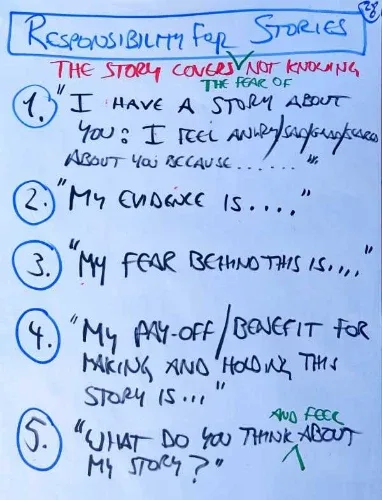
You can do this process with anyone, even if they do not know anything about Possibility Management, or are not invested in Transformation or Healing for themselves. In this process, you go first, you reveal how you have been blocking intimacy and connection with them by holding a story about them instead of entering a small NOW, small HERE Present.
“Hello. I have a story about you: I feel (mad, sad, scared, glad) that you ...” and tell them the story about
them.
Hint 1: It could be that you think that you don’t have a story about the person
across from you. By saying the magical sentence “I have a story about you…”
the story will reveal itself to you.
Hint 2: A story has feeling, be sure that the participants also say the feelings.
2. Human beings are exceptionally smart creatures. We make a story first and
then we look for evidence to support our story. The world is so full of evidence
that anybody can find any evidence to support any story. The second step of
the process is to reveal the evidence: “... and my evidence to support my story
are... (you did this, you said this, with this tone of voice, you look like, etc.)”
3. Why do we make a story about someone? Because there is an unknown, a
piece of information missing. What feeling do we feel when something is
unknown? Fear. The third step of the process is to reveal the fear behind the
story: “... and the fear behind my story is …”
4. Holding on to a story has a shadow purpose, a benefit that feeds our Gremlin.
The fourth step of the process is to reveal the pay-off/the benefit you got out
of holding on to that story: “ ... and the benefit/payoff for my story is… ”
Hint: The shadow payoff is part of your underworld, this is where you will have
to look to find it. This is often the hardest part of the process for people who
do not have the habit of travelling into their underworld.
5. The fifth step is to ask the person who you are telling the story: “ What do you
think about my story? ” The person receiving the story can then tell if the story
was accurate or not or some part were, other weren’t, what touched them,
etc...Stories Re-Spark Imagination
Excerpt from the book: Theory and Practice of Dialogical Community Development by Peter Westoby and Gerard Dowling
While space is crucial for transformational training, stories are also vital resources for training in re-imagination. They potentially provide the models, images and pictures that enable people to imagine a different kind of world.
Two kinds of stories are explored in this reflection – authors and books as written stories, and people, groups and organisations as lived stories.
In many ways, drawing on our understanding of Freire’s practice of dialogue, these stories represent the codes that can be used to trigger conversations within community-based training settings.
Paulo Freire talks about literacy as learning to read both the word and the world. Within this tradition of literacy, learning is not simply about acquiring the function of reading text – a function of learning the word; it is also about the process of becoming conscious that illiteracy is a key symptom of powerlessness.
Illiterate people become aware that their lack of knowing the word is intimately connected to their marginal place in the world.
Within this Freirean tradition of literacy, the ‘reading’ of stories can be conceptualised as acquiring literacy in our imaginative lives.
Story World Experiments
Step-by-step take Radical Responsibility for your Storyworlds
LIST THE STORIES THAT YOU BELIEVE ABOUT YOURSELF
Matrix code: STORYWOR.01
In your Beep! Book make an extensive list of the stories you carry around about yourself. Start each sentence with "I am..." or "I cannot..." or "Nobody ever..." or "The world does not...", for example:
"I am beautiful, cool, not cool, ugly, not worthy, boring, irritating, smart, an idiot, kind, adaptive, crazy, lovable, nice, bubbly, etc..."
Or:
"I am a daughter, a son, a mother, a wonderful wife, a good husband, a cheater, a businessman, an elite, white, black, yellow skin, red skin, brown skin, rich, poor, a refugee, gay, straight, Cuban, German, Buddhist, Jewish,..."
All those stories are part of your Box.
Then write in excruciating detail the story you do NOT want to have about yourself.
Then write in amazing detail the story you would love to Experiment with having about yourself.
Bring these last two stories to your next Possibility Team, stand up, and read them out loud to people. Ask people to share what they feel (angry, sad, glad, scared, and their Reasons why...) after you read each of your stories to them.
After completing this Experiment, please register Matrix Code STORYWOR.O1 in your free account at StartOver.xyz. This Experiment is worth 3 Matrix Points.
KEEP PRACTICING TO TELL A BETTER STORY
Matrix code: STORYWOR.02
At your next Possibility Team arrange to sit in groups of 3 (one person is the Listener, one person is the Speaker, and the third person is the Coach who coaches the Speaker). Spaceholder instructs the Speakers to tell the following kinds of stories for 3 minutes for each of these 4 kinds of stories. After each kind, the Coach and Listener give the Speaker a minute or two of Feedback and Coaching about how to tell a better story. The Speaker makes notes in their Beep! Book or asks a specific question, but there is no Discussion.
- Tell a story that is about the Listener, not about you.
- Tell a story that is worth sharing.
- Tell a story that’s unforgettable.
- Tell a story that makes things better.
Conscious Storytelling is a set of skills. It is not something you are born with. neither is it based on charisma or Authority. Conscious Storytelling may be more simple than you think, but it takes Conscious Practice.
After completing this Experiment, please register Matrix Code STORYWOR.O2 in your free account at StartOver.xyz. This Experiment is worth 2 Matrix Points.
OBSERVE YOURSELF WHILE WALKING IN PARALLEL STORY WORLDS
Matrix Code: STORYWOR.03
Practice Self Observation as you walk 100 meters along the walking zone of your town three times:
1. As a miserable, broken victim living inside an endless tragedy.
2. As the inventive, unstoppable genius on a gloriously epic redemptive quest against all odds.
3. As pure awareness with no storyline.
Make detailed notes in your Beep! Book about your Experiential Reality experiences during each of your 3 walks. Share what your learned during your Self Observation at your next Possibility Team meeting.
After completing this Experiment, please register Matrix Code STORYWOR.O3 in your free account at StartOver.xyz. This Experiment is worth 3 Matrix Points.
PRACTICE CREATING CULTURAL THEATER
Matrix Code: STORYWOR.04
Setup: one small group of performers (2 minimum, 6 maximum) with at least one person as an audience.
1. Everyone together establishes 3 new cultural 'rules' (ie, stories) that are drastically different from what you are used to. For example, one rule could be: "Celebrating your own achievements is itself highly celebrated."
2. For 5 minutes the small group improvise a common scenario such as sharing a family meal WITH the new cultural rules embeded.
3. Repeat with a different set of cultural 'rules'.
After completing this Experiment, please register Matrix Code STORYWOR.O4 in your free account at StartOver.xyz. This Experiment is worth 3 Matrix Points.
DETECT WHICH "I" IS TELLING THE STORY
Matrix Code: STORYWOR.05
At the top of a new page in your Beep! Book write out an exact description of a recent significant event for you in your life - just the event itself, the bare observable facts about what happened with no story attached.
Now let your story maker loose! At your next Possibility Team meeting, study the Egostate website and then tell a story that would make sense out of the event from each of the 6 Egostates:
- Child
- Parent
- Gremlin
- Demon
- Adult
- Archetypal
Ask for Feedback and Coaching from your Possibility Team about the quality and believability of each of your stories. Keep practicing to identify in your daily life which of the Egostates you are telling stories from.
After completing this Experiment, please register Matrix Code STORYWOR.O5 in your free account at StartOver.xyz. This Experiment is worth 3 Matrix Points.
END YOUR DEPENDENCE ON CONCLUSIONS
Matrix Code: STORYWOR.06
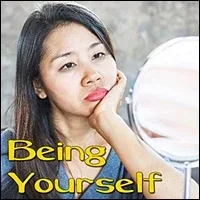
Conclusions are micro stories that end Questioning, Discovery and Evolution. Go for one week without holding onto a single Conclusion. While you are doing this, write down the Conclusions that are most tempting for you to hold onto as true.
Use your Beep! Book to note which Conclusions you have been using as a way to define yourself. "I am this way! I am not that way!" These are Conclusion Stories. Also consider what would happen if you avoid defining yourself by these Conclusion Stories. Report your discoveries to your Possibility Team.
After completing this Experiment, please register Matrix Code STORYWOR.O6 in your free account at StartOver.xyz. This Experiment is worth 5 Matrix Points.

CHECK YOUR STORIES WITH YOUR GAMEWORLDS
Matrix Code: STORYWOR.07
Different gameworlds will accept different kinds of stories. Some gameworlds will only accept logical, intellectual stories, some will only accept intuative, subjective stories. Some will accept only negative stories, some only positive.
Firstly, notice and get clear about what kinds of story the gameworld in which you find yourself accepts.
Then begin to experiment by offering stories (explanations, interpretations, questions, comments, etc) with varying degrees of acceptability in each gameworld. How far can you go? What are the consequences of telling aceptable stories? What are the consequences of telling not acceptable stories?
Bring up the conversation in your gameworlds about the Context of the gameworld and which stories are acceptable and which story are unacceptable. For example, is a 'victim story' acceptable in the gameworld or not?
After completing this Experiment, please register Matrix Code STORYWOR.O7 in your free account at StartOver.xyz. This Experiment is worth 4 Matrix Points.
BECOME AN ARCHEAOLOGIST OF YOUR LIFE'S STORIES
Matrix Code: STORYWOR.08
You lay down the stories of your life like layers of rock in the Earth's crust.
Read through the 18 Boxes website to understand that there are 18 Standard Box designs. If you are not familiar with the term 'Box' as used in Possibility Management, also review the Box Technology website.
Divide your life into 10 era's of roughly equal duration, then identify the main Stories that you layered into your Box during each era.
At your next Possibility Team meeting, present your findings. Tell the Box archeology of your life's stories.
After completing this Experiment, please register Matrix Code STORYWOR.O8 in your free account at StartOver.xyz. This Experiment is worth 3 Matrix Points.
DO THE BRAIN SURGERY TO REWIRE STORIES IN YOUR HEAD
Matrix Code: STORYWOR.09
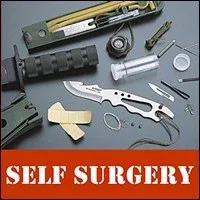
It could be that you have it hard-wired in your brain that stories are 'bad'. When you think about stories, automatically 'bad' comes up. In your brain, stories = bad. It does not take long to rewire your brain and you can do it in the privacy of your own home. This is a brain Self-Surgery.
First, arrange a quiet and undisturbed environment for yourself for at least 20 minutes.
Start in First Position as centered, grounded, and bubbled.
Click your Clicker to Declare your golden cube of working space around you.
You are now ready to start the surgery.
Click your Clicker one more time and move yourself in your own laboratory. One of the spaces that we have access at any time to is our own laboratory. Sit yourself in a chair facing a work-bench with your tools.
This is an energetic surgery and it helps your system integrate the surgery if you move your physical hands along with your energetic hands.
First, wash your hands under hot water with soap. Rinse them and shake them dry.
Open the top of your head with a zipper. The zipper starts above your left ear and goes all around your forehead to end just above your right ear.
Lift the top of your head like the hood of a car.
Your brain is now exposed.
Reach in with your fingers and find the wire that is hooked to the idea of "story". You might have to dig into your brain.
Pull it out in front of your eyes.
What color is the wire "story"?
You will see that this wire is linked with another wire that has the meaning "bad".
What color is the wire "bad"? It will be a different color.
Now pick up your wire-cutters from your work-bench. Cut the two wires were they link up.
Hold the wire "story" in one hand and the wire "bad" in your other hand.
Place the wire "bad" back into your brain - it will find its place by itself.
Now in your left hand, you have the wire "story".
What do you want to wire it with? Think about this for a while. Close your eyes and ask yourself: "What do I want the wire 'story' to be connected to?"
The most powerful and useful wire you can wire "story" to is the other wire "story".
If you want to wire story = story, then feel around with your fingers to find the other wire "story" of the same color. Pull it gently in front of your eyes. Now in your right hand you have the wire "story" and in your left hand the other wire "story". They are both the same color.
To connect the two wires, twist their ends together. Then pick up your soldering iron and melt the ends together. "Shfffit" It will make a sound.
Put down the soldering iron and make sure the two ends are strongly soldered together. If not, solder them again until they are solid.
Now pick up some the roll of tape from your workench of the color as the wire. Tape up the part you just soldered so it looks seamless.
Now put the newly connected 'story = story' wire back into your brain. It will find its place by itself.
The surgery is not over yet. You must still close up your brain. Please lower the lifted part of your skull back down and zip the zipper closed.
Pick up a jar of Zipper Cream from your workbench. Open the lid. What color is the cream?
Take handfuls of Zipper Cream and smear it on the zipper so the zipper disappears. Be generous with the healing cream.
When you are done, close the jar and wash your hands again in warm sterile water. Shake them dry.
Look around and make sure that everything is in order in your laboratory. Then click your Clicker one more time to come back to the space your physical body is in.
Et voila!
When you have done this surgery on yourself, you can hold space to provide that service for others.
After completing this Experiment, please register Matrix Code STORYWOR.O9 in your free account at StartOver.xyz. This Experiment is worth 5 Matrix Points.
USE STORIES AS A TOOL TO INVENT NEW CONTEXT
Matrix Code: STORYWOR.10
Is a hammer true? Is a screwdriver false? Tools are not true or false, they are simply made for a purpose - to get certain things done. Stories are not true or false either, they are simply made for a purpose - to get certain things done, because stories are tools.
Part 1 of this experiment is to complete the above experiment titled: "BECOME AN ARCHEAOLOGIST OF YOUR LIFE'S STORIES"
Then choose at least one story from each era of your life, take a moment to examine it as if it were a tool and answer these 3 questions:
1. What job did you create this story/tool to do?
2. Was this story/tool successful at its job?
3. Is the job that you made the story/tool for still relevant in your life? Or is it no longer relevant?
Part 2 is to review the 50 Thoughtware Upgrades to Archiarchy website, and see if you would like to replace any of your current Thoughtware with the Archan Thoughtware described in the website. If so, please ask a couple people from your Possibility Team to Cavitate Space, Hold Space, and Navigate Space for you to go through your Thoughtware Upgrade Process.
After completing this Experiment, please register Matrix Code STORYWOR.10 in your free account at StartOver.xyz. This Experiment is worth 6 Matrix Points.
NOTE: This website is a Bubble in the Bubble Map of the massively-multiplayer online-and-offline thoughtware-upgrade personal-transformation game called StartOver.xyz. It is a doorway to experiments that upgrade your thoughtware so you can create more possibility. Your knowledge is what you think about. Your thoughtware is what you use to think with. When you change your thoughtware, you go through a liquid state as your mind reorganizes itself. Liquid states can bring up transformational feelings and emotions. Please read this website responsibly. By upgrading your thoughtware you build matrix to hold more consciousness. No one can do this for you. No one can stop you from doing it. Our theory is that when we collectively build one million more Matrix Points we will change the morphogenetic field of the human race for the better. Reading this whole website is worth 1 Matrix Point. Doing any of the experiments earns you additional Matrix Points. Please use Matrix Code STORYWOR.00 to log your Matrix Points earned at this website on http://StartOver.xyz. Thank you for playing full out!
What Are Cookies?
Cookies are bits of information (memory files) stored in your browser by sites you visit. As is common practice with almost all websites, this site uses cookie to improve your experience by remembering your preferences and enable other cookie-based features (e.g. analytics).
Our Cookies
When you submit data through a form such as those found on contact pages or comment forms, cookies may be set to remember your user details for future correspondence.
In order to provide you with a better experience and remember your preferences, we need to set cookies so that this information can be called whenever you interact with a page.
Third-Party cookies
In special cases, we also use cookies provided by trusted third parties like Google Analytics. Third party analytics are used to track and measure usage of this site so that we can continue to produce engaging content.
How To Disable Cookies?
Most browsers let you to refuse to accept cookies. See your browser Help or Tool for how to do this. Be aware that disabling cookies may affect the functionality of this and many other websites you visit. Therefore, it is recommended that you do not disable cookies.